Every single person using social media today is trapped inside a bubble of some sort. Based on the videos and reels we watch, we easily fall into the misconception that we are globally connected—believing that if something happens in any remote corner of the world, it instantly flashes on our phone screens. But that is far from reality. Without your knowledge, social media is designed to lock you inside a tiny, invisible circle.
This phenomenon is known as the Social Media Bubble. While many tech insiders and experts have been exposing this since 2011, it has become a massive talking point recently following the 2026 election results. People are finally waking up to the reality that these bubbles exist, though true awareness is still lacking.
What Exactly is a Social Media Bubble?
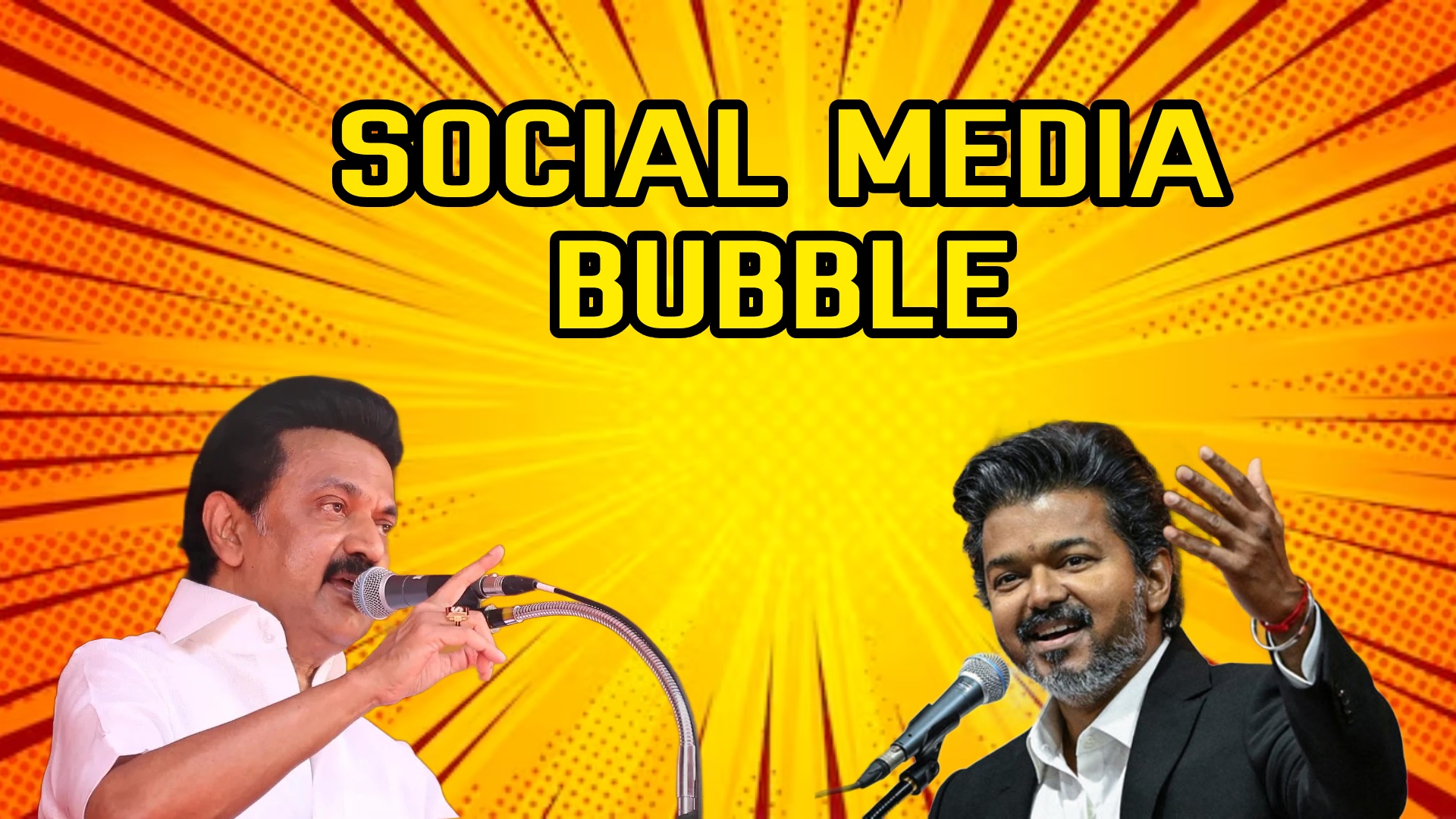
Let’s say an incident occurs in society. Naturally, you develop an opinion on it—you are either for it or against it. Take the recent stampede incident in Karur as an example. The social media space instantly split into two distinct camps:
Group A: Those who supported Vijay and heavily criticized the DMK government of the day.
Group B: Those who opposed Vijay and maintained that the government wasn't at fault.
Now, imagine someone who opposes Vijay creates a piece of content—be it a reel, a long-form video, or a post. They back it up with solid data and valid information, thinking, "I have registered a strong, logical argument here. People will watch this, realize the truth, and switch over to our side."
But think about it: who is the actual target audience for this content? If the creator is opposing Vijay, the target audience should be Vijay's supporters. They are the ones who need to see it.
Here is the twist: In reality, none of them will ever see it. The video might rack up thousands of views and likes, but those metrics come entirely from people who already share the creator's mindset. Not a single view or like will cross over from the opposing camp. Why? Because that is exactly how social media algorithms are designed.
As a result, those who oppose Vijay live in their own echo chamber, while his supporters live in another. What is whispered in one world never echoes in the other.
This is exactly what played out in the 2026 elections. One group lived entirely inside a bubble where they were convinced the DMK would sweep the elections. On the other side, the massive wave of pro-Vijay reels and posts never even crossed into the feeds of the opposing bubble. Ultimately, the group with the larger, more synchronized bubble won the election.
How the Algorithm Controls You
Before we can figure out how to pop this bubble, we need to understand how the algorithm operates. When you scroll through apps like Instagram or Facebook, your every micro-movement triggers a signal to the algorithm:
Watching a reel to the end: Sends a signal that you like this specific type of content.
Watching the same reel 2–3 times: Signals the algorithm that you absolutely love this content.
Swiping away instantly: Signals that you have zero interest in the topic.
Every like, comment, share, and save is a data point. Even pausing your thumb to look at an image for just two seconds sends a distinct signal. With every scroll, your thumb feeds the algorithm intimate details about your psychological profile.
The algorithm then takes this data and says, "Oh, you like this? Here is another piece of content just like it." Furthermore, it finds other users of your age group, location, and psychological profile, showing you what they watched and showing them what you watched. It continuously clusters like-minded individuals into isolated bubbles.
For instance: If you believe the Earth is flat and watch a video on it, the algorithm will flood your feed with "proofs" of a flat Earth. You could live your whole life without ever seeing the overwhelming evidence that the Earth is round.
This is how we get segregated into fiercely opposing camps: TVK vs. DMK, CSK vs. RCB, or Rajini vs. Kamal. We live so deeply inside our own bubbles that we don't even realize how big the opposing side is. If you held a mock election to decide whether CSK or RCB has a larger fanbase, a CSK fan in their own bubble would assume an easy victory, only to be shocked when RCB wins. That shock is the moment the bubble finally shatters.
The realization we all need to have is this: You are not fighting the opposing camp; you are fighting the algorithm.
How to Cross the Bubble: The Role of the "Swing Audience"
To bridge the gap between two isolated bubbles, you need to target the Swing Audience.
Who is the swing audience?
Whenever a major event occurs, there is always a neutral segment of users who are undecided and don't know which stance to take. They are sitting on the fence. Whichever narrative reaches them first with the most convincing argument will pull them to their side.
Going back to the Karur incident, if you wanted to push an anti-Vijay narrative, you would have to reach this swing audience incredibly fast with accurate, verified information. If a neutral user watches your video completely and engages with it, the algorithm notes this and pushes it to other similar neutral users. Sometimes, even casual fans within the opposing bubble might be questioning things; if your content resonates with them, it penetrates their bubble. This is the only way to break through.
Strategy for Content Creators
Attracting the swing audience requires two non-negotiable elements: Speed and Accuracy. You need to deliver verified facts the moment an incident breaks. Because this requires constant monitoring, a single individual cannot achieve this effectively—it demands a well-equipped team that understands narratives and audience psychology.
More importantly, your approach must be constructive. If you try to win over the swing audience or debate the opposing side by using abusive language, throwing tantrums, or calling them names, they will instantly double down and retreat further into their bubble.
In the 2026 elections, a major blunder made by opponents was relentlessly mocking Vijay’s supporters. This toxic negativity only pushed his fanbase to unite and support him even more fiercely. Therefore, your content must remain decent, dignified, and designed to initiate a healthy, intellectual discussion rather than a flame war.
Strategy for Content Consumers
If you are just a casual consumer who scrolls through social media for an hour or two every day, you need to recognize that you, too, are trapped inside a curated bubble.
If you want to break free and see the world objectively, you must frequently clear your digital footprint within these apps:
Clear your Search History
Clear your Watch History
Purge your Saved Posts/Reels
By wiping this data regularly, you force the algorithm to "forget" your preferences. As a result, your feed resets, allowing you to see a much broader, unbiased spectrum of content. Of course, staying inside your comfortable bubble is always an option—but that is a personal choice.
Ultimately, the takeaway is simple: We are not fighting people. We are fighting algorithms, echo chambers, and misinformation.
More Articles